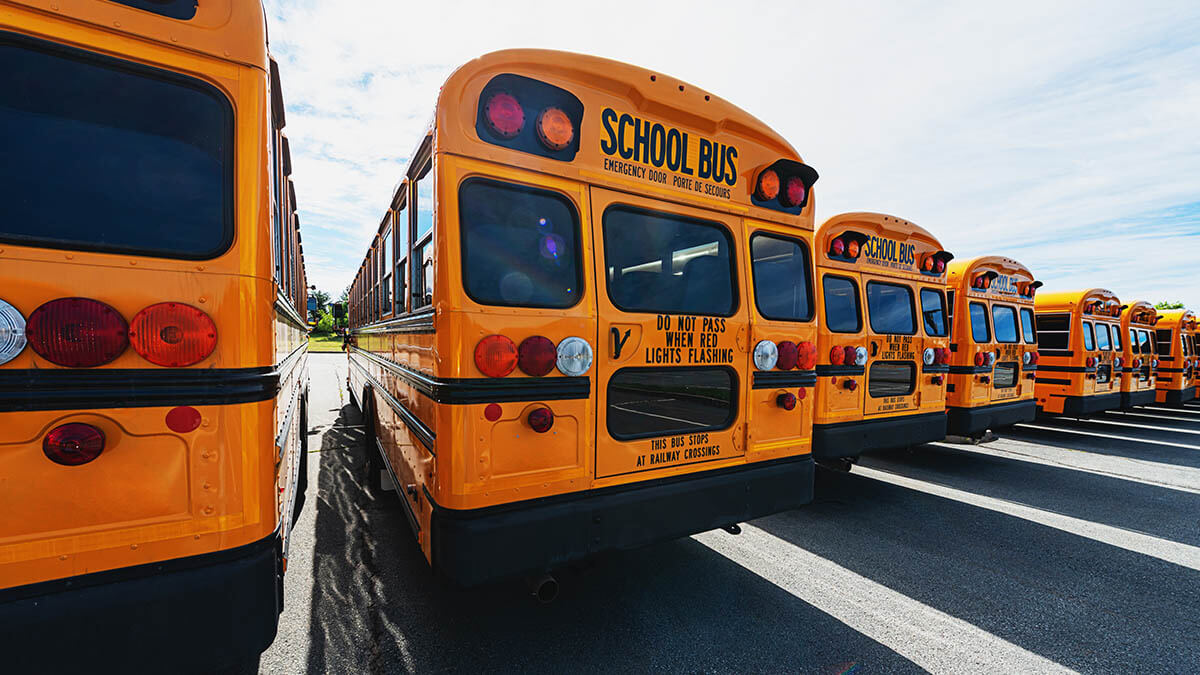
In Bane, the claimant was a school bus driver for the Lewis Palmer School District. On October 18, 2024, the claimant suffered a compensable work injury when he was exposed to exhaust from the school bus that he was driving.
The claimant heard a whirring sound while driving and called dispatch to report the issue. The claimant’s supervisor sent a mechanic to determine what the problem was, and the claimant drove the bus back to the bus barn. The bus had previously been turned over to a third-party vendor after a whirring sound was heard on the bus. The bus was found to have an exhaust manifold gasket leak, which was repaired and reviewed by Respondent-Employer’s mechanics before being returned to service.
The claimant was given a copy of the Lewis Palmer Driver’s Handbook at the beginning of his employment, which required a pre-trip vehicle inspection, a post-trip inspection when the driver returned at 2:00PM, and a third, abbreviated inspection at the end of the day. The inspection checklist was very detailed.
The claimant’s supervisor testified at hearing, and the ALJ found her testimony to be credible and persuasive. The ALJ found that Respondents failed to present any credible or persuasive evidence to support the theory that the claimant violated a safety rule by failing to identify the leaking exhaust clamp in his pre- or post-trip inspections. Respondents appealed this decision, arguing that the claimant was found to have carbon monoxide exposure prior to the admitted work incident and failed to report this exposure for a week during mandated inspections.
The statutory language states that “[w]here injury results from the employee’s willful failure to obey any reasonable rule adopted by the employer for the safety of the employee,” then the compensation provided to the claimant under the Act is reduced by fifty percent.
The Industrial Claims Appeals Office (the Panel) first outlined the statutory language governing a safety rule violation under C.R.S. § 8-42-112(1)(b).
The Colorado Supreme Court has interpreted “willful” to mean deliberate intent, with mere carelessness, negligence, forgetfulness, remissness, and/or oversight not satisfying the statutory standard. See Bennett Properties Co. v. Industrial Commission, 165 Colo. 135 (1968). Respondents bear the burden of proof in establishing that a claimant’s conduct was willful.
The Panel concluded that substantial evidence supported the ALJ’s determination that Respondents failed to satisfy the burden of proof in demonstrating that the claimant willfully violated Respondent-Employer’s safety rule. The claimant’s supervisor testified that she had no knowledge or evidence that claimant failed to complete the mandatory inspections, noting that she had never known claimant to miss an inspection throughout his employment. The claimant’s supervisor also testified that she could not confirm or deny that the claimant had done all pre- and post-inspections during the week of October 13th through October 18th. The supervisor further testified that she recognized that failure to report a leak for a week would constitute a safety violation, but she was unaware of any such failure to report from the claimant.
The claimant also testified that he had performed all inspections as required and did not notice anything wrong with the bus until the date of injury.
Respondents argued that the medical records indicated that the claimant may have been exposed to carbon monoxide for a week. The claimant, however, testified that he had told doctors in the week prior to the work incident that he was not feeling very good and had chest tightness; however, he did not associate these symptoms with carbon monoxide poisoning. The claimant’s testimony was found by the ALJ to be credible and persuasive.
THE PANEL FOUND THAT THE ALJ MADE REASONABLE INFERENCES BASED ON THE EVIDENCE PRESENTED, WITH RESPONDENTS FAILING TO SATISFY THE BURDEN OF PROOF THAT THE CLAIMANT WILLFULLY VIOLATED THE SAFETY RULES IMPLEMENTED BY RESPONDENT-EMPLOYER.
The Panel found no basis to disturb the ALJ’s order and affirmed the ruling that the claimant was not aware that he was exposed to carbon monoxide during his routine, mandatory inspections prior to the date of injury.
Bane v. Lewis Palmer School Dist. #38, W.C. No. 5-287-875-001 (ICAO Jan. 12, 2026).
Want to know more? Contact Luke Peterson at lpeterson@pollartmiller.com
